

A Data Center Debrief: Part 2
In Part 1 of our blog on existing data center laws in Minnesota, we outlined how the laws passed in the state legislature in 2025 address taxes, energy, and water. While some important steps forward were made on energy, significant gaps remain in the law that leave Minnesotans unprotected from the potential impacts of hyperscale data center development.
Hyperscale data centers’ real-world resource demands impact many aspects of our lives: energy, water, air, noise, light, land use, public trust, and the economy, to name a few. Yet Minnesota’s so-called “nation-leading” data center law passed in 2025 only addresses energy and some economics—namely taxes—leaving communities around the state scrambling to understand and address the laundry list of potential negative impacts, virtually on their own.
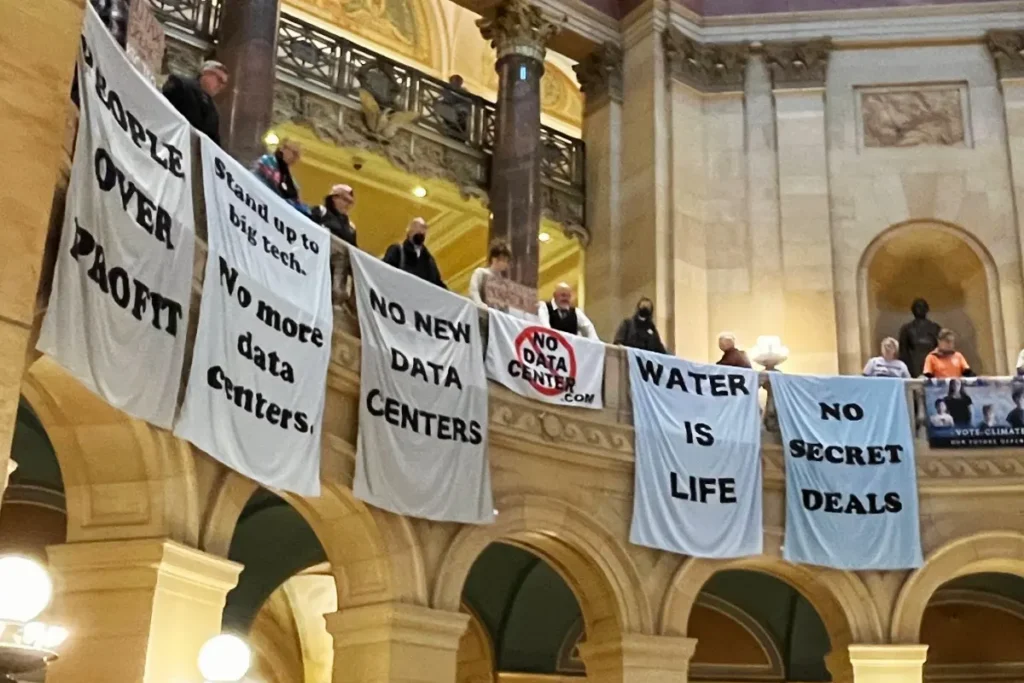
Right now, the only clear winners from Minnesota’s continued lack of comprehensive data center regulation are the big tech behemoths behind proposed projects. That’s why CURE, along with partner organizations and the grassroots organizations fighting data centers in their communities, developed a package of bills in 2026 that would have started to address the impacts left unresolved in 2025.
If hyperscale data centers plan to operate in Minnesota, these are the minimum legal protections our communities deserve:
Data Center-specific Permit
- There is no state-level permit for the data center building, and the associated infrastructure necessary for operating it. Instead, parts of the facility may be permitted individually, at different times, in different venues, before different state or local entities. That makes it tough for members of the public to easily engage in any one process, let alone all of them. It also makes hyperscale data centers very hard for academics and experts to study, clouding these developments behind a thick fog of administrative chaos. A centralized facility permit administered by an expert state agency (in addition to any local permitting under zoning authority) would allow for a comprehensive look at all the potential impacts of a proposed development, from water and energy use to building materials and waste.
Environmental Review
- A robust analysis of the potential impacts of a project—both good and bad—is essential to the health of our communities and shared resources. Plus, it’s required by law. Local governments have relied on Alternative Urban Areawide Reviews (AUARs) for environmental review. But the AUAR process lacks consistent detail and sufficient opportunities for meaningful public engagement. The AUAR is clearly the wrong tool for this job and putting it on local government units is an unfair use of local government resources. Requiring all hyperscale data centers to undergo a mandatory Environmental Impact Statement, overseen by an expert state agency, ensures needed opportunities for public engagement and a thorough analysis of potential impacts while minimizing the risk of legal challenges and delays down the road. Doing it right the first time saves everyone time and money.
100% Clean Energy from the Start
- Data centers are massive electricity users. Every hyperscale data center built to date has a large fleet of diesel or gas generators outside the building, creating local and global climate pollution for emergency backup power needs. All of these facilities’ power needs should be supplied by clean resources—solar and wind, paired with sufficient storage—from the start. And to help reduce electricity demand in the first place, the state should require developer investments that reduce peak load (and allow peaks to be shifted to when renewables are generating the most).
Enforceable water quality and quantity protections
- There is no dispute that the 2025 law fell short when it comes to protecting our shared water resources. Hyperscale date centers piggybacking onto a municipality’s existing water permit is still possible and likely, creating a black box around a data center’s actual water use. For example, Google’s proposed data center in Hermantown plans to obtain all of its water from the municipal system. But it is not clear from the AUAR just how much water that might be. Hyperscale data centers—and all large water users—should obtain their own independent permits even if they receive water through a municipal water system with a municipal permit. In turn, those facility water permits should come with requirements to publicly report monthly and annual water use, report the type and amount of any additives introduced to water used at the data center, and contain enforceable water reuse or efficiency measures.
Community Protections
- Minimum setback distances, restrictions on noise and light pollution, and Community Benefit Agreements are largely left to individual cities to decide whether to regulate, if they choose to do so at all. To avoid a race to the bottom where local governments shed regulations to attract new projects, the state should create enforceable minimum requirements so that all communities can enjoy the same protections, no matter their population, resources, or location.
Nondisclosure Agreements (NDAs)
- The widespread use of NDAs, pushed by data center developers and the tech giants that use them, has broken public trust in many elected officials and local government staff. The use of NDAs for these kinds of projects should be restricted to restore public trust and shield local governments from unfair practices of massive corporate firms
Electronic Waste
- Hyperscale data centers update and dispose of their computing equipment every two to five years. Minnesota has no enforceable requirements for how an end user might reuse, recycle, or dispose of used computer technology. Because current state regulations and guidelines for recycling and managing e-waste are insufficient and generally do not apply to these huge new sources of e-waste, the potentially thousands of tons of e-waste from these facilities could pile up in Minnesota landfills or municipal garbage burners that pollute low-income communities. Minnesota must strengthen its e-waste regulations, but hyperscale data centers should also be required to abide by an enforceable e-waste management plan and report on the status of their compliance annually.
Without clear statutory requirements or guidelines that speak to these issues, Minnesota communities are left to fill in the gaps themselves.
Some have already started to act, passing data center-specific ordinances (like Monticello), and even employing temporary moratoriums to give their communities time to study the impacts of this development and develop regulations (like Mankato). See CURE’s website for an up-to-date map of the moratoriums and ordinances passed in Minnesota. But because the wave of hyperscale data centers is already here, communities are trying to figure things out while their local governments are being actively courted by developers, sometimes behind the protection of an NDA. For local leaders, these discussions with wealthy tech companies can create a sense of urgency and a desire to offer the best deal possible—for the developer or end user and not usually the community—to capture the project and its promised economic benefits. Moving too quickly and without public input or an eye for the long-term harmful impacts of such development can come at the expense of the community, the rest of the local economy, and potentially destroy public trust.
It is not unreasonable for Minnesotans to want to fully consider the ramifications of a hyperscale data center before welcoming one into their community. These facilities will typically be used by some of the wealthiest companies in the world, who can and should pay their fair share and undergo careful scrutiny. It is not too much to ask that these companies, if located here, be good neighbors who minimize harm while making meaningful contributions to local taxes and community services. In fact, any company that doesn’t want to accept that may not find themselves welcome in Minnesota’s notoriously friendly communities.
CURE and our partners at the local, state, and national levels will continue to advocate for a robust and fair data center framework—one that guarantees adequate opportunities for authentic public engagement, provides communities with the structures needed to protect public health, the environment, and local business, and prioritizes transparency over secrecy.
By Sarah Mooradian, Government Relations & Policy Director, CURE